Memorial of Saints Cornelius, Pope, and Cyprian, Bishop, Martyrs
In today’s first reading, Paul wrote to Timothy on how bishops should act and what characteristics they should have. Today’s Gospel is about Jesus raising a widow’s son from the dead during his funeral procession. Both readings can teach us about discipleship.
Memorial of Our Lady of Sorrows
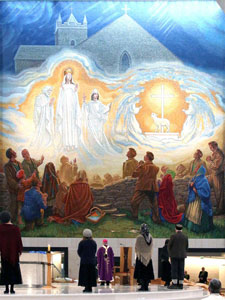
This past summer all 13 Cronins (my children and grandchildren) traveled in pilgrimage to the shrine of Our Lady of Knock in County Mayo, Ireland. A-once-in-a-lifetime event to the land of our ancestors, there we gave thanks for the life of Mary Tighe Cronin, my wife and their mother/grandmother. Mary’s parents came from Tuam in County Galway, a 20 minute drive from Knock.
Memorial of St. John Chrysostom, Bishop & Doctor of the Church
When facing the challenges of life, today’s gospel story reminds us of the importance of having a firm foundation. As Christians, Jesus is our rock and foundation. When we recognize our need for Christ in our lives, rely upon the gifts that He gives, spend time nurturing our relationship with Him, and follow Him in word and deed, we will deepen our foundation. Our lives will not be without challenges or storms, but with our lives rooted in Christ we will recognize that we are not alone, since our support comes from God who is always near.
Friday of the Twenty-third Week in Ordinary Time
“Hyppo, hyppo, hyppo!!,” my teenage son likes to teasingly call me (no, not a hippopotamus) when he catches me doing the very thing I told him not to do. Maybe Jesus would use that slang if he were here now rather than, “You hypocrite!” that we read today in Luke’s gospel passage from the Sermon on the Plain. Why do we notice the splinter in our brother’s (or sister’s or spouse’s or coworker’s or parent’s or neighbor’s or enemy’s) eye, but not notice the wooden beam in our own?
Thursday of the Twenty-third Week in Ordinary Time
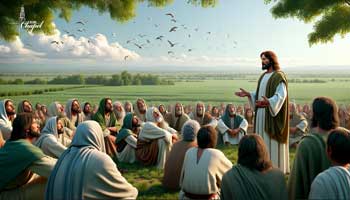
Today Luke presents Jesus’ “Sermon on the Plain," as opposed to Matthew’s “Sermon on the Mount.” The whole of this section of Luke reveals the truth of what is required for discipleship. And it is costly. This runs against the antithesis of grace, a grace we confer on ourselves, what the great German pastor and martyr of World War II Frederick Bonhoeffer derided as “cheap grace.”
Wednesday of the Twenty-third Week in Ordinary Time
Where are you? St Paul provides the answer in our first reading. It may surprise you! Paul exhorts us, “If you were raised with Christ, seek what is above, where Christ is seated at the right hand of God . . . For you have died, and your life is hidden with Christ in God.” So, where are you? Your answer, partly, is wherever you find yourself geographically at this moment in time. The deeper reality, however, is that your life is hidden with Christ in God. This truth sounds abstract and esoteric, doesn’t it? It’s mysterious and perhaps not easy to understand. How can Paul make these statements so categorically? It’s because of our Baptism! We died with Christ in the waters of our Baptism and were raised by the Holy Spirit to a new life in Christ.
Memorial of Saint Peter Claver, Priest
Today is the Memorial of St Peter Claver, a Spanish Jesuit priest and missionary (1580-1654), known as the patron saint of slaves, Colombia and ministry with African Americans. Leaving his family wealth, Peter added to his perpetual vows in the Society of Jesus, a personal one, "to be a slave of slaves". For 38 years, he worked in the port city of Cartagena, Columbia tending to the physical needs and ministering spiritually to those arriving on slave ships.
Feast of the Nativity of the Blessed Virgin Mary
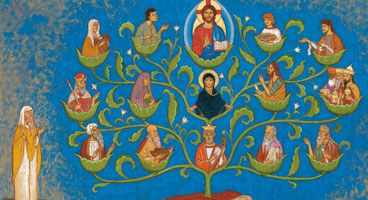
Have you researched your family tree? DNA opens vistas we couldn't have imagined just 10 years ago. I have researched my family tree back to the 13th century in some instances. The line that assisted me to do that included those who were assigned by English monarchs to govern the “within the pale” parts of Ireland in and around Dublin. Most surprising of all is my finding two canonized saints as very distant cousins: Mary McKillop of Australia and Oliver Plunkett, archbishop of Armagh and primate of all Ireland.
Saturday of the Twenty-second Week in Ordinary Time
Some thirty years ago, Bill had a conversation with his sister-in-law that he will never forget. They were driving back to Bill’s house after a day visiting museums in Washington, DC when they somehow got onto the topic of certainty and Christianity. Bill’s sister-in-law (I’ll call her Joanne) was absolutely convinced that to be a true Christian, required certainty about the faith. A true Christian, she argued, is someone who understands the central tenets of the faith and knows they are true. It's not enough to be convinced or to be nearly sure or to observe the practices of the faith but have some doubts about this or that doctrinal point. To be a Christian, you have to know. Without certainty, you are failing to commit to the faith. You are sitting on the fence.
Optional Memorial of St. Teresa of Calcutta
You’ve likely heard the saying “What would Jesus do?” (WWJD) that became quite popular some years ago with wrist bands, bracelets and t-shirts sporting the message. Well, reflecting on today’s optional readings for the Memorial of St. Teresa of Calcutta (also known as St. Mother Teresa), I found myself asking a similar but different question – What would I do if this person were Jesus?
Thursday of the Twenty-second Week in Ordinary Time
Today’s readings remind us that having a community of believers is essential to growing in faith and building the Kingdom of God. Through prayer, encouragement, and communal liturgies, we accompany one another as we seek to find God in all things.
Memorial of St. Gregory the Great, Pope & Doctor of the Church
Luke locates today’s Gospel account at the start of Jesus’ ministry. If you go back to the beginning of Luke 4, it’s quite the whirlwind of experiences! Jesus spends his forty days in the wilderness being tempted by Satan; he proclaims the Isaiah text (61:1-2) that prophesied his Messianic identity and mission in the synagogue in Nazareth, following which he is run out of town by a furious mob; he exorcises a demon in the synagogue in Capernaum; and news spread like wildfire throughout the region as people shared their amazement about his teaching and his miracles. Next, Jesus visits the home of Simon (Peter) at the request of the family. Jesus heals Peter’s mother-in-law, and then proceeds to heal many more people and cast out more demons. Jesus attempts to get away to rest and pray, but the crowds find him and continue to press him for more miracles. If they would have had paparazzi in Jesus’ day, I’m sure they would have been all over it! In the midst of the hectic launch of Jesus’ earthly ministry and his rapid ascent to notoriety, it’s Peter’s mother-in-law’s response that I find the most intriguing.
Tuesday of the Twenty-second Week in Ordinary Time
Years ago, I met an American missionary who was assigned to Haiti. His main ministry there was as an aide to a priest who did exorcisms. The stories the missionary told of his time there were crazy, wild, and fascinating much like the story in today’s Gospel of Jesus and the man with an unclean demon. We learn about Jesus’ power and authority as he tells the demon to be quiet and come out of the man. The witnesses there were amazed at what happened and speculated as to who Jesus was. Unlike the missionary I met, we may never see such a spectacular feat, so what can this Gospel passage mean for us today?
Monday of the Twenty-second Week in Ordinary Time
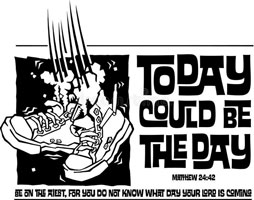
Back in the early ‘80s, as I began my 33 years at Saint Xavier High, I recall certain parents dropping off their sons on North Bend Road and then, before pulling out of the lot, glancing back to see if the boy was still there. They wanted to make sure that he wasn’t “raptured.”
This was the time when the “Left Behind” series sold over 80 million books, making the “rapture” popular, based on what we hear today in I Thessalonians 4:14-17. Millions became obsessed with these books.
Saturday of the Twenty-first Week in Ordinary Time
There are some scripture passages that always leave me scratching my head and wondering exactly what Jesus is trying to reveal about God. Today’s reading about the parable of the talents is one of those stories. As I reflected on the passage I was struck by the phrase “Come, share your master’s joy.” Where does this joy come from and why are the two servants invited to join in the celebration?
Memorial of the Passion of St. John the Baptist
It’s interesting how the far the account of John the Baptist’s death in today’s gospel reading parallels the Jesus’ passion narrative. Both Herod, in this passage, and Pilate in the passion narrative hold the power of life or death over persons they acknowledge to be holy and both operate out of fear. Herodias and the crowds stand in the place of the accusers: they hold such hatred for these men because of John’s and Jesus’ teaching, which challenged the way that they lived their lives. Both John and Jesus were given a proper burial by respected people who requested their bodies from the authorities. This similarity is notable because today we celebrate the memorial of the “martyrdom” of St. John the Baptist. “Martyr” in an interesting word. In Greek it means “witness” and in the early Church it came to mean those who died for the sake of Christ. Often their deaths had, or were narrated as having, parallels to Jesus death. This is especially clear in the account of St. Stephen, often called the first martyr, in the Acts of the Apostles (See Acts 7).
Memorial of St. Augustine, Bishop & Doctor of the Church
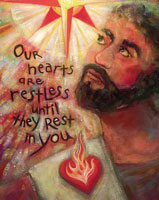
Today we hear from I Thessalonians, the oldest writing in the New Testament (49 CE). The oldest verse in the entire New Testament is, I Thessalonians 1:1: “Paul, Sylvanus, & Timothy to the Church of the Thessalonians…” The three missionaries named were leaders of the early Church. But there are many early leaders whose names never landed in the scriptures or in the writings of the early Church Fathers.
Memorial of St. Monica
Today we celebrate the feast of St. Monica, a mother known for her persistent prayer for her son, Saint Augustine. If you know anything about St. Augustine’s story you know that he did not always live the life of a saint. Yet his mother persistently prayed for his sanctification and conversion. We too, are called to pray in this same way for the people we love.
Tuesday of the Twenty-first Week in Ordinary Time
When was the last time an authority figure said something like “explain yourself” to you? It can well up anxiety, quick thinking, and perhaps even the temptation to spin a lie. Or it can be an opportunity for teaching or reviewing the truth. We all want the truth, but we don’t want to get in trouble for it; rather we want to be believed and understood. I wonder if Jesus and Moses felt this way when the taught the people the Law, parables, and new commandments. They were each laying out a radical new way of life for their followers. They each really want the people to ‘get it.’ But even those immediate followers often seem to fail at understanding; is it any wonder we get confused as well?
Monday of the Twenty-first Week in Ordinary Time
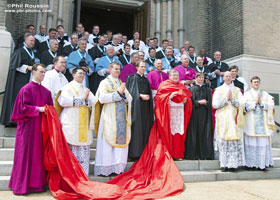
Photo by Phil Roussin; Source: https://www.flickr.com/photos/pbr-photos/14817553966
Defamers of the Catholic Church frequently quote today’s words of Jesus, “Call no one father,” as a repudiation of religious honorifics of any kind. Our dear Pope Francis used to tease those addressing him as “Holy Father” by returning the favor with “Holy Son” or “Holy Daughter.”