Memorial of Saint Ignatius of Loyola, Priest

As we hear in today’s Gospel, Jesus favored parables—short allegories featuring people, places, and things familiar to ordinary listeners—to get his point across. These parables are centered on the Kingdom of God, in stark contrast to the Kingdom of this world.
Wednesday of the Seventeenth Week in Ordinary Time
In today’s Gospel, Jesus teaches us about the Kingdom of Heaven. As Christians we strive to reach the Kingdom of Heaven. Our hope is in Jesus who tells us that when we die from this world we will be born again into new life, in the kingdom of heaven. We are taught that if we follow Christ’s example and live as He did that we will one day join Him in paradise, in the kingdom. But let’s take that one step further. When we pray the Our Father, the prayer Jesus himself taught us, we are striving for something more. We are striving to bring that illusive, unknown kingdom here on Earth. We are told the Kingdom of Heaven is not only meant for our life after death, but it is our goal to create that Kingdom here and now on Earth.
Memorial of Saints Martha, Mary, & Lazarus
Today’s Memorial recognizes the gift of three siblings who were close friends of Jesus and often welcomed him into their home. In 2021, Pope France introduced the additions of Saints Mary and Lazarus to the memorial of St. Martha, giving us a wonderful opportunity to reflect on our role as families and communities in relating to Jesus. The lectionary gives us two gospel story options - both full of emotion and honest dialogue with Jesus, showing the intimacy and trust that the three siblings had in Him.
Monday of the Seventeenth Week in Ordinary Time
For every backyard gardener invasive weeds can be maddening. In our area this is especially true of chick-weed and honeysuckle. Neither are native plants. On Arbor Days, back in the 1940s & 1950s, honeysuckle was sent home with school children to plant. A poor choice as when you think this plant has been eradicated it pops up again with renewed vigor.
Memorial of Saints Joachim & Anne, Parents of the Blessed Virgin Mary
You may recall the “What Would Jesus Do?” phenomenon that took especially young Christians by storm in the early 1990s. It emerged when a young youth pastor in Holland, Michigan resurrected the question on behalf of a grassroots movement she started in hopes of inspiring Christian youth to become more active disciples of Christ. Participants in the movement were reminded throughout their day of this pressing discipleship question whenever they glanced down at their wrists and saw the trademark token of the movement: a solid color woven bracelet featuring the acronym WWJD. Of course, the bracelets (and t-shirts and ball caps and all the rest) also served as identity markers for who was part of this movement—and who was serious about following Jesus.
Feast of St. James, Apostle
In today’s gospel reading from Matthew (20:20-28) we are reminded that Jesus isn’t about power and status and striving to be first. Jesus uses the question posed by James’ and John’s mother to instruct his disciples in what they (and we) should be striving for: to serve others. Jesus poses the question to the brothers, “Can you drink the cup that I am going to drink?” And although they say “yes”, they don’t yet get what is being asked of them. How many of us have been eager to say “yes” in life, perhaps with a youthful enthusiasm, only to later realize that it would be harder than we thought?
Thursday of the Sixteenth Week in Ordinary Time
In both scripture readings today, the people in the stories encounter God. Throughout our days, we too have opportunities to encounter God in various ways. Do we recognize God in our daily lives?
Wednesday of the Sixteenth Week in Ordinary Time
Honestly, I’m not much of a gardener. I've overwatered and underwatered plants and accidently cut plants that weren't weeds. However, I lived with Marianist Sisters who are great gardeners. Whenever I have observed them growing plants from seed, I’m always struck by how much time and care they take. They get rich soil, are attentive to how much water and light to give, and keep track of the seeds’ growth. From these Sisters, I gain a better understanding of Jesus’ parables and metaphors that reference planting.
Feast of St. Mary Magdalene
First, it’s important to note that today is a feast! In 2016, Pope Francis elevated the memorial of Mary Magdalene to a feast day, putting her on a more equal footing with the other apostles. She was, after all, the “apostle to the apostles” – the one to whom Jesus entrusted the news of resurrection and the one sent to tell the other apostles.
Monday of the Sixteenth Week in Ordinary Time
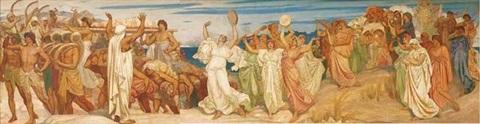
Our first reading today anticipates the well known parting of the sea in Exodus. Our Responsorial Psalm celebrates the event.
These writings are beloved of movie makers, providing spectacular cinema. The 1956 Cecil B. de Mille film The Ten Commandments thrilled audiences with the then novel visual effects that parted the Red Sea with walls of water rearing up and exposing the sea bed allowing safe passage for the Hebrews.
Saturday of the Fifteenth Week in Ordinary Time
In Psalm 136 today, we hear: “Give thanks to the Lord, for he is good, for his mercy endures forever.” Freed us from our foes? His mercy endures forever. Split the Red Sea? His mercy endures forever. Led Israel through its midst? His mercy endures forever.
Friday of the Fifteenth Week in Ordinary Time
“That same night they shall eat its roasted flesh with unleavened bread and bitter herbs.”
The word maror (מרור) in Hebrew means “bitter herbs” or, simply, “bitterness.” From the moment God instituted the Passover meal, the bitter herbs have been an essential item on the menu. They are a symbol and a tangible reminder of the anguish of slavery.
Thursday of the Fifteenth Week in Ordinary Time
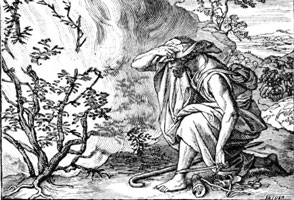
Then Moses said to God, “If I come to the people of Israel and say to them, ‘The God of your fathers has sent me to you,’ and they ask me, ‘What is his name?’ What should I tell them?” God said to Moses, “I am who I am.” And he said, “Say this to the people of Israel, ‘I AM has sent me to you” (Exodus 3:13-14).
Who gave you your name and why? For most of us our names are integral to who we are. Can we imagine having any other name than the one we have?
Wednesday of the Fifteenth Week in Ordinary Time
As we approach today’s Gospel, I invite you to call to mind children whom you know. Think about what characterizes these and other typical children. You might recognize their innocence, playfulness, inquisitiveness, joy. Jesus tells us that if we are to understand the things of God, we must be childlike. Let’s explore what it means to approach our faith in a childlike manner and ask our heavenly Father to gift us with a childlike heart and mind.
Memorial of St. Bonaventure, Bishop & Doctor of the Church
Do the works of God seem ‘normal’ to you? We participate in Mass week after week, year after year. It’s easy to get used to the way God works in our lives. Is conversion a word that brings more static memories than dynamic and present questions? This is most of us, and it’s who Jesus is speaking to in today’s Gospel. The difficult thing about God’s call is its constancy. God loves us always and every day. The Spirit enlivens us every day. So it’s very easy to take the every-day and let it be background noise that gets ignored. The reality is more nuanced. God’s everyday presence has different words for each different daily situation. As we move from season to season in our lives, God speaks the words we need to hear. The tough thing is to keep listening.
Memorial of St. Kateri Takakwitha, Virgin
“Do not think that I have come to bring peace on the earth. I have not to bring peace but the sword” (Matthew 10:34). What are we to make of such a statement from Jesus?
Isaiah wrote that the Christ would be the “Prince of Peace.” Luke tells us that a choir of angels over Bethlehem announced his birth singing, “Peace on earth.” One of his Beatitudes is “Blessed are the peacemakers.” On that first Easter Sunday night, the Risen Jesus greeted his disciples with, “Peace be with you.”
Saturday of the Fourteenth Week in Ordinary Time
Pop quiz! Who in one of the readings for today posed this question?
- Pontius Pilot
- Saint Peter
- Judas Iscariot
- Saint Paul
- None of the Above
Memorial of St. Benedict, Abbot
Maybe having so many heart-wrenching stories in the news recently of families being separated against their will – especially parents and their children, even if adult children, whether it be a result of immigration and deportation enforcement or the tragedies of war or of natural disasters such as the recent flooding in Texas – maybe these have something to do with my heartfelt reaction to the reunion of Joseph and his father, Jacob (Israel), in today’s reading from Genesis’ 46th chapter.
Thursday of the Fourteenth Week in Ordinary Time
In today’s gospel reading, Jesus sends out his disciples to proclaim that the Kingdom of heaven is at hand. One of the central parts of Jesus directives involves sharing peace with the people that the disciples encounter. We are also called to bring God’s peace to the world, since it is this peace that is an important part of bringing the Kingdom of heaven to earth.
Wednesday of the Fourteenth Week in Ordinary Time
I’m entitling my reflection today “Hard Mercy,” because I believe that true mercy is revealed and extended in the deepest depths of pain and suffering. At times we may exercise mercy as a “soft skill,” offered casually in situations that don’t cost us much personally. True mercy shows itself most when it comes at great personal price and inner sacrifice. Mercy can only be modeled after the Cross of Calvary. Joseph exemplifies this kind of mercy. Today, may we grow in our understanding of God’s mercy toward us and may we be filled with mercy toward even the most difficult people in our lives.