Saturday of the Twenty-Fifth Week in Ordinary Time
Both of today’s readings are difficult and discouraging to read. The first reading from Ecclesiastes talks about the sun darkening, the pitcher shattering, the pulley breaking and falling, etc. It’s almost apocalyptic. In the Gospel, Jesus tells his disciples that he will be arrested (which will lead to his crucifixion and death), but they do not understand. What does this all mean? Like the disciples, do we understand what is being said?
Memorial of Saint Vincent de Paul, Priest
Today we celebrate the Memorial of St. Vincent de Paul, the French priest who dedicated much of his life to serving the poor. This feast has a special place in our hearts because he is also the namesake saint of our oldest son. In our gospel, Jesus asks his disciples, “Who do you say that I am?” (Lk 9:20) It is a striking question for us to consider. Might we attribute the voice of that question today to Jesus, St. Vincent de Paul, and even to ourselves?
Thursday of the Twenty-fifth Week in Ordinary Time
Poor Herod. He had John the Baptist beheaded at his daughter’s request (see my previous reflection on August 29 for more on that). Behind the scenes was Herodias, Herod’s wife, who found John the Baptist very threatening. She wanted him dead. Herod found him unsettling, though he was also aware that he kept wanting to hear what John the Baptist had to say.
Wednesday of the Twenty-fifth Week in Ordinary Time
Part of my weekly Saturday routine is to make a meal plan for the meals we will prepare in the coming week. Then I use this to make the grocery list. I compile a list of all the food we will need to feed my family of 6 for the week. It is usually a long and expensive list of food. I often find this planning process to be a tiresome chore, but I know that being able to not only plan in this way but to purchase food before it is needed makes me rich indeed.
Tuesday of the Twenty-fifth Week in Ordinary Time
Today’s Scriptures invite us into the process of discernment. It is a difficult challenge to truly listen deeply, and to hear what is meant by the other—through the Word of God in Scripture, or the voices of my brothers and sisters—be they my neighbor, co-worker, part of my Family of Parishes, or relatives in my extended family.
Memorial of Saint Pius of Pietrelcina, Priest

“No one lights a lamp to conceal it or place it under a bed. Rather they place it on a lampstand so that all may see the light.” —Luke 8:16.
“When others see us, may they not see us but the Christ light shining through us.” —CS Lewis.
Our light, who is Christ, was meant to shine through those inflamed with his light. Have you met such persons along the way, those who “shine like the sun”? Christ-light people (“Christ-lighters”) have an inner serenity which adversity cannot ruffle. They have a strength that illness cannot weaken. They have a confidence that not even dying can wipe away. Their inner light shines from deep within – the light of Christ.
Feast of Saint Matthew, Apostle and evangelist
In today’s Gospel, Jesus calls Matthew to follow him. Remarkably, it seems that Matthew gets up and follows Jesus without hesitation. The passage doesn’t imply that anything else happened to Matthew before the encounter or during the interaction with Jesus. This story can help us reflect on our call from God. When God calls do we follow? How have we followed God’s call for us?
Memorial of Saints Andrew Kim Tae-gon, Priest, and Paul Chong Ha-sang, and Companions, Martyrs
Today’s short gospel passage from Luke (8:1-3), just three verses, may not seem noteworthy at first glance, but it is rich in what it conveys about the important role of women in Jesus’ ministry. “Accompanying him were the Twelve and some women…who provided for them out of their resources.”
Thursday of the Twenty-fourth Week in Ordinary Time
Throughout the gospels (including today’s reading), Jesus says, “Your faith has saved you.” What might Jesus be saying to us about the importance of faith and mercy in our lives?
Wednesday of the Twenty-fourth Week in Ordinary Time
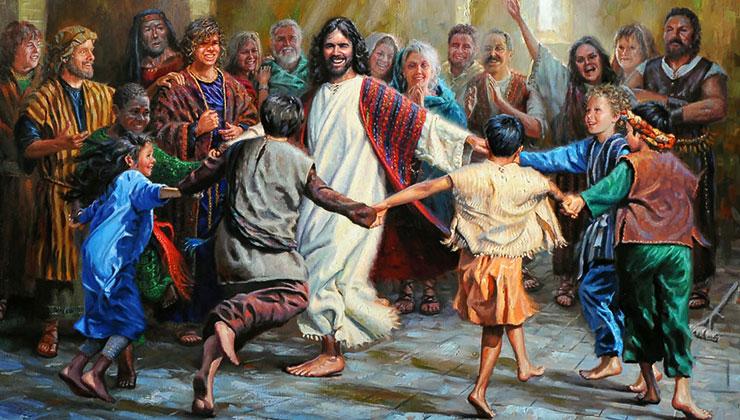
Where have spontaneous children’s games gone in our era of “play dates”? Myself a baby-boomer, in the ‘50s & ‘60s neighborhood children would race home after the final bell, change their school clothes, finish up homework (or at least say we did) and then run out to join the myriad of kids outside (large families were common in baby-boomer days). Playing hard, we would leave the fun once the “street lights came on.”
Tuesday of the Twenty-fourth Week in Ordinary Time
Reflecting on today’s readings, I can’t help but hum the hymn to myself: “We are many parts, we are all one body. And the gifts we have, we are given to share…” Singing together is such a powerful way to establish group identity. When many voices join in one song, our unity as God’s people, the Body of Christ, is made clear. We make it a point in our family to sing hymns together. It’s a simple, easy way to make the ‘Church at home’ a real part of our daily experience. We’re not great singers. But we like to sing, and it becomes a beautiful prayer to God, even when my voice or my children’s voice sounds a little hard on the ears! It doesn’t have to be perfect to have a positive effect on our life of Faith.
Memorial of Saints Cornelius, Pope, and Cyprian, Bishop, Martyrs
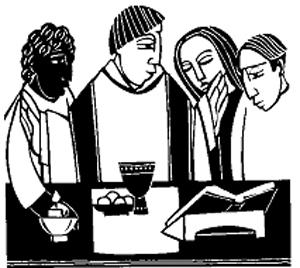
We hear familiar words in both readings today, familiar because they are spoken during the most important action of the People of God — the Mass. We hear or recite those words every time we gather to break-the-bread and to drink-the-cup.
Feast of the Exaltation of the Holy Cross
Today we celebrate the Feast of the Exaltation of the Holy Cross. This feast traces back to when St. Helena discovered the True Cross in Jerusalem during a pilgrimage in the Holy Land. The Basilica of the Holy Sepulcher was built on that site and the cross was soon venerated.
Memorial of Saint John Chrysostom, Bishop and Doctor
This week, I had the special privilege of visiting the Paul Laurence Dunbar House and learning more about the gifted and prolific poet and author from Dayton. It is a national historic site, and I strongly recommend visiting. During my visit, I was struck by this quote from one of his writings in the 1890s, “So you must but bear in mind that the agitation of deeds is tenfold more effectual than the agitation of words. For your own sake, and for the sake of Heaven and the race, stop saying, and go doing.”
Thursday of the Twenty-third Week in Ordinary Time
If anyone wonders what it means to follow Jesus, the text before us today from Luke makes it clear. And it is one tall order.
Wednesday of the Twenty-third Week in Ordinary Time
The readings today are challenging on many different levels. Paul’s letter to the Corinthians on first glance seems to be calling us to a life of celibacy. Indeed, in this section of Corinthians, Paul suggests, “let even those who have wives, be as though they had none.” These words were Paul’s opinion based on the reality of the situation as he understood it.
As it was Paul believed that the Christ’s return was imminent. This letter was some of the first New Testament writings, penned even a decade before the first gospel. Paul, along with many in the early church, believed that Christ would return within their own lifetimes. It is with that understanding that today’s reading is best reflected upon. For Paul, there was no need to marry. Paul suggests that the world, in its present form is passing away. Paul like a good parent is trying to protect his spiritual children.
Tuesday of the Twenty-third Week in Ordinary Time
Jesus departed to the mountain to pray, and he spent the night in prayer to God.
–Luke 6:12
Many Gospel stories tell of Jesus taking time away from the crowds and his devoted followers to be alone with God in prayer. The busier the days, the more he awoke early, or made sure to depart to a ‘lonely place’. In today’s Gospel, he heads to the mountain—whose heights give a fresh outlook and whose clefts give a place of shelter through the night.
Memorial of Saint Peter Claver, Priest
“You are inflated with pride.” - 1 Corinthians 1:2
Today Paul comes down hard on the community of believers at Corinth because of their exaggerated pride, rightly labeled “hubris.” He assails the Corinthians for being "puffed up" or "arrogant."
Saturday of the Twenty-second Week in Ordinary Time
In the first reading, Paul writes that he and another preacher, Apollos, have become a spectacle. A spectacle refers to something unusual, notable, or entertaining. In a way, Paul suggests that we are to be Christian spectacles by emphasizing, “We are fools on Christ’s account.” He compares his condition to the Corinthians by describing himself as “weak” and “in disrepute” and the Corinthians as “strong” and “held in honor” in order to remind them to focus on Christ’s message and to be a witness to the Reign of God, a place where present conditions are reversed. He gives examples in his letter, “when ridiculed, we bless; when persecuted, we endure; when slandered, we respond gently.”
Friday of the Twenty-second Week in Ordinary Time
“Therefore, do not make any judgements before the appointed time, until the Lord comes, for he will bring to light what is hidden in darkness, and will manifest the motives of our hearts, and then everyone will receive praise from God.” This last verse from today’s reading from Paul’s first letter to the Corinthians (4:1-5), stood out to me – especially the last phrase, “then everyone will receive praise from God.” ! It makes me wonder, was Paul using some sarcasm there? Or being encouragingly optimistic about the motives of the people of Corinth’s hearts?