Wednesday of the Fourth Week in Ordinary Time
Have you ever misunderstood someone via text because you ‘heard’ the text with a tone that the sender did not intend? This experience comes to mind as I pray with the gospel today. “Where did this man get all of this? What kind of wisdom has been given him?” The questions themselves aren’t bad questions. They could have been asked with wonder and awe, “Wow! He’s one of us! Isn’t it amazing that we are seeing this new side of him? Isn’t it wonderful how he’s grown into the man before us?”
Tuesday of the Fourth Week in Ordinary Time
Our approach in life varies depending of course on the situations in which we find ourselves. Most people are who they are until a crisis seems to change the rules. When we look inward and truly reflect on our reality, we begin to understand we need an approach connected to something bigger than ourselves.
Feast of the Presentation of the Lord
As a kid growing up in the pre-Vatican II era, we referred to February 2 as “the last day of Christmas.” Since the reforms of Vatican Council II it is “the Presentation of the Lord” (and sometimes “Candlemas”). Now the Advent/Christmas cycle ends on the Feast of the Baptism of the LORD. Still February 2 commemorates the Holy Family as observant and obedient Jews, true to Mosaic Law.
Memorial of St. John Bosco, Priest
I attended a retreat where we reflected on the topic of awe and wonder. In today’s gospel story the disciples were filled with awe while on the lake with Jesus. Although Jesus is not walking the earth today, I wonder how often God’s creation and power is providing opportunity for our awe? What can we do to be more aware of these experiences in our daily lives?
Friday of the Third Week in Ordinary Time
Often when people hear Jesus’ parable in today’s Gospel, they think of the mustard seed growing into a majestic tree. However, the mustard plant is more like a weed. Once its very small seed takes root and grows, it overtakes the crops it grew next to and becomes hard to get rid of. Ironically, Jesus compares the Kingdom of God to this pesky plant. So what is Jesus trying to tell us?
Thursday of the Third Week in Ordinary Time
Today David cries out, “Who am I, O LORD God, and what is my house that you have brought me thus far?”
Like David, we might consider all that the LORD has done and wonder who we are that the Almighty LORD of the universe has brought us thus far. Grateful that Jesus came so that we might be sons and daughters of his Father, we may ask “who are we” that this greatest and most undeserved gift of all (Christ) has been given us?
Memorial of St. Thomas Aquinas, Priest & Doctor of the Church
“Let us build a house where love can dwell, and all can safely live…” As I read 2 Samuel today, these lyrics from the hymn “All are Welcome” sing in my soul. David, with his typical enthusiasm, is eager to build God a house in which to dwell. God pushes back a bit, though, “Did I ask you to build me house?” God reminds David that God has been journeying with the people in the moving tabernacle, under cloth. God does promise a day when God will raise one from David’s lineage to build a temple. We know that One to be Jesus the Christ!
Tuesday of the Third Week in Ordinary Time
Consider the last time you were at a party that was very clearly happening to celebrate God’s presence in our lives. Maybe it was a baptism, confirmation, or carefully-prepared Christmas celebration. Some weddings are also a clear celebration not only of the couple, but of God’s love for us. Whatever your memory can supply, consider that party and the party portrayed in today’s reading from Samuel.
Memorial of Saints Timothy & Titus, Bishops
Today, we celebrate St Paul’s right hand and left hand: Timothy, whom Paul sent to oversee the church in Ephesus, and Titus, whom Paul sent to oversee the Christian community in Crete.
Given that he is my own patronal saint, I hope you’ll allow me to go on a bit about Timothy today.
Memorial of St. Francis de Sales, Bishop & Doctor of the Church
Scripture Readings
The Gospel text from Mark today is really short—uncharacteristically so for the Catholic Liturgy. And it makes just three simple claims.
Here are the three claims:
- Jesus’s ministry was enjoying great, even shockingly great, success. The crowds were so big that they could hardly figure out a way to eat.
- People from Jesus’s home town (family and friends) were present and witnessing Jesus’s preaching and the crowd’s enthusiastic response.
- And their response to Jesus: “He’s out of his mind.”
Friday of the Second Week in Ordinary Time
We make choices every day. Some simple, some difficult, some easy, some without much thought, some with much deliberation and prayer. Today’s readings speak to me about our choices, our free will, and what we do with those choices primarily as disciples of Jesus.
Day of Prayer for the Legal Protection of Unborn Children
It seems that many people long to be noticed and even praised for the things that they do. In both readings today, we see two holy men who are great in their service of others, but recognize the potential danger in seeking attention for the deeds they do. As disciples, Jesus shows us that doing what we are called to do with humility and love is the best way to give glory to God.
Memorial of St. Agnes, Virgin & Martyr
David’s courage in today’s first reading is famous. David feels for his people and wants to make a difference. His eagerness to serve and willingness to face the giant is admirable. The giant takes one look at him and judges him not to be up to the task. David and his five small stones prove formidable.
Jesus’ courage in today’s gospel may not be as clear. However, he knows that ultimately this act is one of many small acts of compassion and love on behalf of the most vulnerable that will ultimately lead him to the cross. The Pharisees watch Jesus closely, judging him, waiting for an opportunity to accuse him of breaking the religious law. Jesus reminds them of the law by asking a question. In this simple question, Jesus points out that while the law says no work is to be done on the sabbath, the law also allows for the work of giving life in the face of death and deep woundedness. Jesus points out to them that sometimes our conventional boundaries must be crossed so that the ultimate law of love can be fulfilled.
Tuesday of the Second Week in Ordinary Time
In our first reading, Samuel has called the whole town of Bethlehem together for a banquet. Everyone is supposedly there, including Jesse and his sons, one of whom will be the next king. The sons are dressed up and looking their best. But the Lord reminds Samuel, and us, that the outward appearance is not an accurate way to judge.
Monday of the Second Week in Ordinary Time
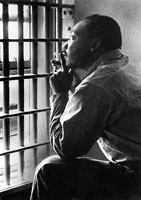
Today we hear in Mark that some religious leaders in Jesus’ day refused to budge when it came to the law. Even when the law makes no sense or was oppressive, the law, for them, became even more supreme.
On this holiday we remember the voice of a prophet named Martin Luther King, Jr. Like Jesus, he refused to accept law without question, arguing that there are bad laws as there are bad men.
Memorial of St. Anthony, Abbot
As I sat down to prepare this reflection, what immediately jumped out at me from today’s Gospel is the question posed to Jesus’ disciples by the Pharisees, Why does he [Jesus] eat with tax collectors and sinners? You and I, we are the tax collectors and sinners. Quoting Psalm 14, St Paul tells the Romans, “None is righteous, no, not one” (Rom. 3:10). We are all sinners. I invite you to put yourself in Levi’s shoes as you pray and meditate upon today’s Gospel and ask yourself, why does Jesus invite me to his Table? The answer is life-giving!
Jesus came to get his feet and hands dirty, to smell like the sheep he came to shepherd, to take on himself all the gritty, grimy, filthy reality of the fallen human condition. The Incarnation is all about Jesus becoming like us (in every way but sin) so that through his Paschal Mystery we can become like him in his divinity. Last Sunday we celebrated the Feast of Jesus’ Baptism, where he entered the muddy waters of the Jordan, already polluted by the sins of the people coming to John for baptism. Jesus immersed himself in the chaotic, contaminated water because of his unfathomable mercy; his limitless, sacrificial love plunged him into the murky depths so that his divinity could purify it for us. This is incredible love!
Why does Jesus eat with tax collectors and sinners? Because he loves us. Pure and simple. Jesus eats with us, fellowships with us, hangs out with us, and restores us to covenant relationship with the Father because he loves us and wants to lead us home to be with the Holy Trinity forever.
Why does Jesus eat with tax collectors and sinners? Because we need to be healed/saved. Overhearing the query, Jesus responds, “Those who are well do not need a physician, but the sick do.” Already in Mark’s Gospel, Jesus has displayed his power to heal the sick. But the sick referred to here are the tax collectors and sinners! The most crippling ailment we can ever experience is sin. As God says through the prophet Hosea to Israel, “I will heal their faithlessness; I will love them freely . . .” Hos. 14:4. Jesus demonstrates to us that he is indeed the Divine Physician. God wills and works for what profits us for salvation; we must admit our abject need and turn to the Lord asking him to heal us of our sin. Through the Sacrament of Reconciliation, God not only forgives our sins but brings deep healing to our souls, minds, and bodies as we yield to his merciful work within us.
Why does Jesus eat with tax collectors and sinners? Because Jesus wants to restore us to divine fellowship. Our sin separates us from God, and Jesus longs that you and I might enjoy joyful, free, and intimate fellowship with him and the Father and the Holy Spirit. Jesus further clarifies his response, “I did not come to call the righteous but sinners.” His call is the invitation to the Messianic banquet. Jesus points forward here to the Eucharist, the ultimate feast, the dinner that he hosts for all of us sinners redeemed by his blood. Does Jesus imply that the morally upright are not included in his call? No, the key here is that we are all sinners, none is righteous, and we must admit and own our sinfulness, our unrighteousness. If we behave like Pharisees, considering ourselves worthy and “those other sinners” to be unworthy, we exclude ourselves from Jesus’ call, his invitation to his Table. Let us not ever deceive ourselves and so refuse Christ’s medicinal grace. Jesus did not come to vindicate those who faithfully kept the Law and exclude everybody else. We all need to be healed from the devastating effects of sin. And to those of us with pharisaical tendencies, a word of hope: Jesus came to heal the sickness of pride and judgmentalism, too!
We might spend time today contemplating Christ on the Cross. Behold his immense love for you; consider the extent to which our pure and divine Savior was willing to dirty himself with our humanity and to die a brutal death for our sake; pour out your gratitude and thanks to him, express your love back to him. And when you go to Mass this weekend, celebrate the Eucharist like never before, marveling that Jesus wants to eat with tax collectors and sinners.
I’ll see you in the Eucharist,
Elizabeth Wells
Friday of the First Week in Ordinary Time
Have you ever gone to an event that is so crowded that you can’t even get in the door? Were you discouraged and decided to leave? Persistent and hopeful that you might still get in or at least catch a glimpse or hear a little from where you were standing? How motivated were you to find another way in? Motivated enough to have your friends break through the roof and lower you down?! Today’s gospel reading from Mark (2:1-12) invites us to reflect on our place in the story of the paralyzed man who was lowered through the roof of the home where Jesus was preaching.
Thursday of the First Week in Ordinary Time
Although out of season, Washington Irving’s The Legend of Sleepy Hollow names the hapless central character Ichabod Crane, (a biblical name meaning the glory is no more). Irving may have gotten that name from 1 Samuel 4, which we hear today, wherein the son of a priestess is given that unholy name due to distress and fear. God, it would seem, had abandoned his own — all because the Chosen People had descended (or tried to) into a relationship of “mutual manipulation” with the One who chose them! In 2026 it is highly unlikely for sons to be named Ichabod. Washington Irving saw to that!
Wednesday of the First Week in Ordinary Time
God wakes us from our sleepiness and calls our name. This is Samuel’s experience in the temple. Samuel, who was already “a minister to the LORD,” and yet lived in a time when “a revelation of the LORD was uncommon and vision infrequent.” I wonder, was God infrequently revealing God’s self to the people? Was God not speaking and showing who God is and the path the people were called to walk?
Tuesday of the First Week in Ordinary Time
The first reading and the Gospel reading do not necessarily have to be connected to each other, and that seems to be the case in today’s readings. However, I found that they both have prayer in common. What can today’s readings tell us about prayer?