Tuesday of the Third Week of Lent
At this point in the year, partly because my work is on the academic calendar and it is the middle of the semester, I usually find myself becoming very busy. It’s easy for me at this time to become stressed and to feel as though I’m not going to get everything done. It makes sense to compare these times of stress to a fire that burns—or maybe smolders—in my life. Lent, too, can feel like a burning fire. It’s not always pleasant to be fasting—in fact it can be painful. But the fire of Lent can also be seen as a fire of purification that is supposed to burn away what is excessive or unwholesome and to prepare us for the feast of Easter.
Monday of the Third Week of Lent
Coming home to Nazareth was risky. Neighbors and family remember him running around as a toddler with a load in his diaper. Town gossip questioned his parentage. They recalled the gawky, adolescent Jesus. He’s back home after going down to Judea to join up with another one of those wacky apocalyptic movements, this time with an unhinged wild man at the River Jordan. In very little time, his hometown had had it with him.
Saturday of the Second Week of Lent
When reflecting on the readings for today, the word “extravagant” comes to mind. The definition of extravagant is “exceeding what is reasonable or appropriate, absurd.” All of the readings point to the extravagant mercy of our God. As we reflect on this scripture, the challenge for us is can we open our hearts and minds to receive this outpouring?
Friday of the Second Week of Lent
Envy: “painful or resentful awareness of an advantage enjoyed by another joined with a desire to possess the same advantage” (merriam-webster.com)
Thursday of the Second Week of Lent
“Blessed are they who hope in the Lord” (Ps. 40:5a) is today’s psalm response. The first reading from Jeremiah picks up on this theme of hope in a dramatic comparison between a barren desert bush and a tree planted beside waters. While the former never changes in its barrenness, the latter never changes in its fruitfulness. Those who hope in God are “always green,” always full of life, regardless of the circumstances. This passage from Jeremiah ends with the intriguing verse that the LORD rewards “everyone according to his ways, according to the merit of his deeds” (Jer. 17:10). What makes this verse intriguing is its juxtaposition with the gospel passage. At the time of Jesus, and even now at our time, there is a tendency to look upon those who suffer or struggle and think that God is somehow punishing them, or, using the phrase of Jeremiah, we might say that God is rewarding them “according to their ways, the merit of their deeds.” But, of course, if we look closely at this passage, we see that Lazarus ultimately is rewarded by eternal life and eternal comfort, whereas the unnamed rich man receives eternal torment.
Wednesday of the Second Week of Lent
Our Gospel passage always cuts me to the quick. I find myself shocked and outraged at the audacity of James’ and John’s mother and her disregard for Christ’s revelation of his Passion. And yet I recognize myself in her. Sorrowfully I must admit my own selfishness, self-centeredness, and propensity to seek to elevate myself. As we meditate upon and contemplate today’s Gospel, let us insert ourselves into this story. And may I invite you to identify with this mother and her sons. Consider the ways in which their tendencies are your own. Then, let us gather at the foot of the Cross to not only find forgiveness for our preoccupation with self but also to allow Christ to raise us up in authentic elevation.
Tuesday of the Second Week of Lent
Prince of Gomorra! What a name! Why is Isaiah calling his readers this? There must be some bad people that the sacred author is addressing, right? But rather than punishment or vengeance, God is calling for repentance. ‘Set things right. Make justice your aim.’
Monday of the Second Week in Lent
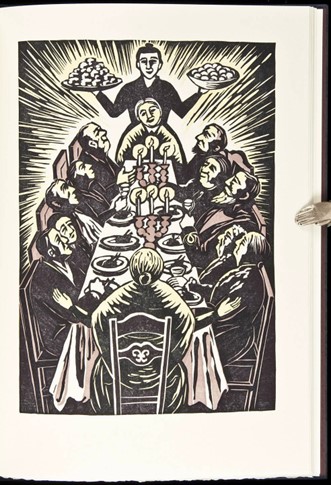
Daniel addresses the Lord today as “great and awesome God.” We might add the word “lavish.” And the more we share God’s gifts, the more abundant they become.
Friday of the First Week of Lent
‘That’s not fair!’ How many times in life have we heard this exclamation? I hear it often as a parent. And in some instances, I’m the one making the cry. At every turn and in every situation, there is a cry for “fairness.” I’m not sure how I feel about the typical response that I received from my parents as a child though: ‘Life’s not fair, get over it.’ While the first part may be true, the second part is callous. In our first reading, God poses the question, “Is it my way that is unfair, or rather, are not your ways unfair?” (Ez 18:25b) The only way to live in the image and likeness of God is by falling in love with God. This is the dynamic of our first reading. Because of a profound love for God, the wicked person turns from his wickedness, and lives. On the other hand, the virtuous person rejects God’s love, and dies. What a critical lesson for our early days of Lent–lesson on the fair and just ways of the Lord. How might we fall more deeply in love with our good God and open our hearts to the work of the spirit in us? How can we allow the practices of prayer, fasting, and almsgiving to help us discover the best version of our true selves.
Saturday of the First Week of Lent
Perfectionists. Do you know one? I’ve struggled with perfectionism in my past many times - the obsessiveness of not only following the rules and laws but judging yourself is nothing I wish on another person. However, when Jesus asks us to follow His command of loving, there seems to be a freedom to being a perfectionist - a perfectionist for love.
Thursday of the First Week in Lent
When I started writing reflections for Ite Missa Est in early June of 2017 I thought of it as a form of service to our (now) family of parishes. But it didn’t take long for me to realize that writing these reflections is not just service. It is also a gift—to me. And that is because I have learned so much in doing this every other week. Just spending time with Scripture that I either had never read or very rarely read was a gift.
Wednesday of the First Week in Lent
“A heart contrite and humbled, O God, you will not spurn,” cries our psalmist today. Let our cry for a contrite heart arise today, as well. Our readings today inspire me to think about the depth of my contrition for my sins. How humble am I? How contrite am I? On an imaginary scale of contrition, am I somewhat sorry, mostly sorry, sorry, very sorry, or extremely sorry? And if extremely sorry, can I say that I’m “sold out” in my contrition? How deep is my sorrow for my sins? In what ways does that sorrow compel me to respond to God?
Tuesday of the First Week of Lent
For how many of us is prayer more like our own monologue than true dialogue with God? I know this is often the case in my own life. And sometimes this is ok. Sometimes it is sufficient to just pour out our soul to God. He is there to listen. God wants us to speak to Him. But this is not all that prayer is. Lent is a season of prayer. All liturgical seasons, by definition, are seasons of prayer. But Lent is a special season, because, like Advent, Lent is a spiritual pilgrimage. In Advent our pilgrimage is to the Nativity, to Jesus' birth. In Lent, our pilgrimage is to the Resurrection, to Easter. But Lent is a pilgrimage at a whole other level as well. More than any other season, Lent is a time of transformation. The practice of physical pilgrimages has a long history in Christianity. Physical pilgrimages, unlike tourism or vacations, are intended to transform the pilgrim. You return from a pilgrimage a changed person because of a holy encounter, and because of the spiritual practices which transformed you throughout the pilgrimage. Lent is intended to be a similar experience, even if you never leave your hometown. We return home from Lent via the resurrection of Jesus in the joyful Easter season. The goal is to be a transformed people.

Monday of the First Week of Lent
Amen I say to you what you did not do for one of these least ones, you did not do for me. - Matthew 25:45
Saturday after Ash Wednesday
Like some people, I am a little anxious when it is time to head to the physician. Whether there is a specific medical issue or a routine check-up, there is this underlying fear that I am not as healthy as I think I am or should be. In today’s gospel, Jesus reminds the scribes and Pharisees that he has come to bring healing to the sinners. How many of us are fearful to admit our sins to Jesus, similar to the fear we have when addressing our medical needs with our physicians? Today’s scripture readings remind us that we are all sinful, but our God is all merciful and desires to bring us healing and wholeness. Jesus is the Great Physician who offers His prescriptions and directives for good spiritual health, but we can only receive His grace through our humble admission that we need His care.
Friday after Ash Wednesday
As I happen to be writing this reflection for Friday on Ash Wednesday, the issue of fasting is front and center on my mind (and stomach). A hungry stomach keeps alerting my mind to its state, which I find makes it harder to focus and easier to become irritable with my husband. Apparently I’m not very advanced with this discipline. Fasting is front and center in both of today’s readings as well. But perhaps not as you’d expect.
Thursday after Ash Wednesday
As human beings, we don’t like suffering. For the most part our inclination is to avoid suffering. And yet it’s also part of our human experience and cannot be avoided. Sometimes we go to great lengths in attempting to avoid suffering. We try to avoid illness and harm to ourselves and loved ones and we try to prolong death and extend our lives as much as possible. Most of us, if given the choice each day, would choose life. Today’s readings talk about choosing life or death in a spiritual sense.
Ash Wednesday
Today is Ash Wednesday, the beginning of our Lenten journey toward the Cross and through the Cross into the glory of Christ’s Resurrection. The Church, through our readings, invites us to humble ourselves, turn away from our sin, repent, seek reconciliation with God, and devote ourselves to prayer, almsgiving, and fasting. I feel led to focus my reflection on the second reading, in which St Paul implores us to be reconciled to God. In gratitude to the One who became sin for our sake, may we today seek reconciliation with God so that we might become the righteousness of God in Christ.
Tuesday of the Seventh Week in Ordinary Time
What are we to make of the fact that so often in the Old Testament we are admonished to fear the Lord yet in the New Testament Jesus instructs us repeatedly not to fear? Is this some kind of contradiction between the Old Testament and the New? Is there any way to reconcile these two apparently incommensurate teachings?

Monday of the Seventh Week in Ordinary Time
Jesuit theologian Karl Rahner wrote, “In the midst of our lives and our struggles we have to make a radical, absolute decision. And we never know when lightning will strike out of the blue. It may be when we least expect to be asked whether we have the faith and trust to say ‘yes.’”