Thursday of the Fourth Week of Easter
In the last four weeks since Easter, we have been following the story of the early Church. Recent readings have emphasized the importance of the inclusion of the Gentiles. But today we hear Paul preaching in a synagogue at the invitation of local synagogue officials. How interesting! Christianity was now unambiguously open to Gentiles in the eyes of the early Church, and yet, Paul had not given up on sharing the message of the Jewish Messiah with the Jews. Moreover, Paul and companions remained comfortable in the synagogue, which had been their place of prayer for their entire lives.
Feast of Saints Philip and James, Apostles
Today is the Feast of Saints Philip and James, Apostles. In the Gospel, we hear Philip make a request of Jesus, “Lord, show us the Father and that will be enough for us.” As happens so often with the Apostles and with us, we ask the Lord for things and have no idea what we’re talking about or the implications of what we’re asking. Jesus’ response to Philip reveals the essence of the Holy Trinity, our relationship with God, and our call to evangelize. These two saints whom we venerate today are among the foremost examples of what it means to witness to Christ and share the faith. Let us ask their intercession today that we might know the Father’s love more deeply, understand who we are in the family of God, and have courage and boldness to “do even greater things than these.”
Memorial of Saint Athanasius, Bishop and Doctor of the Church
Alleluia, Christ is risen! As we continue to celebrate Easter, we hear the story of the early Church. Last week we heard of Stephen’s martyrdom, and today we learn that some believers were scattered by the subsequent persecution (led by Saul, who became the apostle Paul after his conversion). The gospel message of Jesus’ life, death, and resurrection was so exciting and so joyful that these believers simply could not keep it to themselves. They fled persecution, but they continued spreading the word of this Messiah. They even began to share it with Gentiles, like the Greeks, who had not been awaiting a Messiah as had the Jews. And yet, through the grace of God and by the power of the Holy Spirit, these Gentiles also came to believe. We have this beautiful line from the Acts of the Apostles that, “it was in Antioch that the disciples were first called Christians” (Acts 11:26).
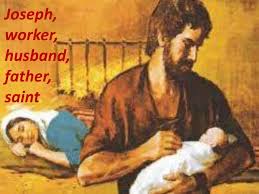
Saint Joseph has many titles: Patriarch, Son of David, the Just Man, Savior of the Savior, Patron of Refugees, Terror of Demons, Head of the Holy Family, Patron of the Dying, Model of Artisans, Patron of the Universal Church. I have always liked the title, “Saint Joseph the Provider.” A school in Youngstown is named this in Joseph's honor.
Memorial of Saint Catherine of Siena, Virgin and Doctor of the Church
“As a result of this, many disciples returned to their former life and no longer walked with him” (John 6:66). Jesus’ revelation of Himself as the Bread of Life, the one whose flesh we must eat and whose blood we must drink to gain eternal life, was not easy to swallow (no pun intended). Indeed it separated the deeply committed disciples from those who were on board only insofar as Jesus’ teaching seemed acceptable. This particular teaching shocked the latter group (John 6:61) and they returned to their former life. In response to their shock, Jesus remarks His words are “Spirit and life” (John 6:63).
Friday of the Third Week of Easter
This week, I had the privilege of chaperoning a senior Kairos retreat. I love the meaning of Kairos–God’s time. Retreats were always a powerful experience for me when I was in high school so now as an adult, especially now that I’m a parent, it is special to journey through the experience with our CJ students. As an adult leader, one of my roles was to present a talk at the retreat. I won’t share my entire talk but our gospel today connected with some of the messaging that I pray our retreatants took away from Kairos this week. While teaching in the synagogue in Capernaum, Jesus teaches that “Whoever eats my Flesh and drinks my Blood remains in me and I in him.” (Jn 6:56) One thing that I hope they took away from this week is that we were created with and for deep purpose; not just to be individuals but part of the Body of Christ.
Thursday of the Third Week of Easter
The Ethiopian eunuch that Phillip encounters at the urging of the angel of the Lord is, obviously, a big deal. The text informs us that he is “a court official of the Candace, that is, the queen of the Ethiopians.” Moreover, we are told that he is “in charge of her entire treasury,” a huge responsibility, to be sure. There he is sitting in his chariot, reading the prophet Isaiah. The angel tells Phillip to go to him, which Phillip does. And he asks the eunuch, “Do you understand what you are reading?” The eunuch’s reply is worth noting. He says, “How can I, unless someone instructs me?”
Wednesday of the Third Week of Easter
In today’s Gospel we encounter Jesus giving what’s known as his “Bread of Life Discourse.” Jesus reveals himself as “the true bread from heaven . . . who comes down from heaven and gives life to the world” (John 6:33). In Jesus our deepest hunger and thirst are satisfied; in Jesus every need is met. Where and how does Jesus accomplish this for us? In the Eucharist. Today I pray that we might all be drawn irresistibly to more frequent reception of the Eucharist, to receive Jesus who truly is the Bread of Life for us.
Feast of Saint Mark, evangelist
Humility is not an attribute that people in our culture find appealing. And yet, I believe that humility is an essential part of being a disciple of Jesus. Some people think that being humble entails feeling worthless or being self-effacing, but I do not think that this is humility, and behaving this way is not what God desires. In order to be humble in the eyes of God, we must recognize that who we are and everything we have are gifts from Him. We do not deny our goodness or blessings, but give credit to God who showers us with His grace. When we are able to openly accept that we are nothing without Him, then He is able to use us completely to do His works as we help to build His kingdom.

Monday of the Third Week of Easter
Acts of the Apostles is proclaimed almost daily throughout the fifty days of Easter, Luke’s sequel to his Gospel. Acts is a great Easter book and “the Gospel of the Holy Spirit.”
Saturday of the Second Week of Easter
Today’s readings show how the apostles’ faith evolved over the course of time. From frightened and uncertain men, to people boldly proclaiming the Word of God, these followers of Jesus were drastically changed by their encounter with Christ. As disciples of Jesus, we also are given the opportunity for our faith to evolve as we encounter Christ in our daily lives.
Friday of the Second Week of Easter
Do you remember as a child sometimes looking at the world upside down? Hanging from the monkey bars, or swinging with your head tilted way back, or dangling from your parents arms to see the world from a different perspective? Or if you’re braver than me, maybe you’ve gone on the upside down rides (with your eyes open) at amusement parks or fairs. Well, this week’s readings seem a little upside down or backward to me, resulting in a different – and new – perspective.
Thursday of the Second Week of Easter
Obedience is a word that carries a lot of baggage with it. Especially in our culture today, there is a certain resistance to being obedient or subservient to those is authority. Understandably, there are certain situations in which power and obedience to authority is abused, and I think that fear of abuse or misuse of such power is legitimate. Unfortunately, it seems to have resulted in a negative connotation for obedience even to God. I did not study Latin in school, so it was only more recently that I learned that the word ‘obedience’ comes from the Latin word obaudire, meaning “to listen, to hear.” This sheds a different light on the word, especially with regard to our call to obedience to God.
Wednesday of the Second Week of Easter
Today we have a marvelous opportunity to bask in God’s love. I invite you to sit back, relax, and soak in the love of the Holy Trinity, much like you might soak in a luxurious bath – only it’s so much better. Allow God’s love to surround you, support you, swirl within you. Immersed in God’s love, allow yourself to be drawn ever more deeply into God’s presence and listen for the voice of Love whispering to you the sweet assurance that God truly loves you, desires to be in relationship with you, and has a plan and purpose for your life.
Tuesday of the Second Week of Easter
The first reading for today describes the life of Jesus’ disciples after his resurrection. It describes Jesus’ followers as a community and states that his followers were “one in mind and spirit.” Rather than having private property they “had everything in common.” The reading goes on to state that no one in the community of believers was needy. When new members joined the community, they would sell what they had and distribute the proceeds to those who were in need.
Monday of the Second Week of Easter
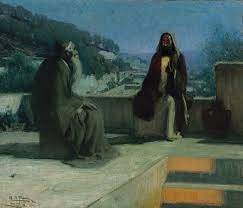
Nicodemus Syndrome: Living the faith only when no one else is around.
Saturday in the Octave of Easter
These words from today’s Psalm (Ps 118:15) illustrate the insuppressible good news of Jesus’ life death and resurrection. The good news of the resurrection bubbles forth from Jesus’ disciples out of their gut, almost uncontrollably; it is unable to be squelched or held down. In the reading from Mark’s gospel today, Mary Magdalene is the first witness to the resurrected Jesus (Mark 16:9). In John’s endearing account of this same appearance, we are told that Mary didn’t recognize Jesus at first, but mistook him for the gardener (John 20:15). In Mark’s account, we learn nothing of the exchange between Mary and Jesus, only that after He appeared to her, “she went out and told his companions” (Mark 16:10), who summarily dismiss her story. It is interesting that Mark only tells us of these two verbs “he appeared” and “she told.” Mary is not even commanded by Jesus to tell the others, but it seems she cannot contain herself. She cannot hold in this joyful news.
Friday in the Octave of Easter
The stone which the builders rejected
has become the cornerstone.
By the LORD has this been done;
it is wonderful in our eyes.
This is the day the LORD has made;
let us be glad and rejoice in it. (Ps 118:22-24)
Both the first reading and the psalm call attention to Jesus as the cornerstone. A cornerstone is historically the first stone placed for the building’s foundation, typically strong, solid, and often beautiful. Today, cornerstones are strategically positioned for prominence, often inscribed with a date of establishment or commemoration of something significant. However, in our case the builders turned (and often continue to) our backs on Christ, rejecting him, rejecting the love of the Father. Yet Christ fulfills his promise; he is our savior, the cornerstone.
Wednesday in the Octave of Easter
We have two very powerful readings today, and I’ll admit I’m feeling mute in response to each of them. Many thoughts, impressions, and reflections stir within me, but I’m reluctant to put too much into words today. I feel led to invite you to sit with our first reading and the Gospel and see what the Lord causes to well up within you. I invite you to make these readings intensely personal today. I offer a brief reflection only to prime the pump of your own deeper reflection.
Monday in the Octave of Easter
For Christians Easter is like Ohio, “the heart of it all.” Every chapter, every verse, every word of the New Testament is permeated with Easter. “We are Easter people and Alleluia is our song” (Saint Augustine). But do we put more energy into Lent than Easter? We spend 40 days preparing, and then celebrate Easter as if it’s a single day.