Thirty-third Sunday in Ordinary Time
Latest data tells us that the richest 1% own 86% of the world’s wealth. In the United States, top 20% of Americans own 86% of the country’s wealth and the bottom 80% of the population own 14%. I begin with my homily with these statistics not only because of staggering the inequality, but also because in a Capitalist economy such as ours, the parable of the talents (Mt 25:14-30) might make us conclude that the top 1% are the heroes of the parable, and that the rest of us are lazy, incapable, or plain stupid. After all, the master said, “For to everyone who has, more will be given and he will grow rich” (Mt 25:29). If the master in the parable represents God, and the servants represent us, it becomes very important that we interpret this parable correctly, least it become a tool for oppression.
Thirty-second Sunday in Ordinary Time
These are not the easiest days for us either as a nation or as the world. We find ourselves caught within the turbulence and turmoil of a political contest unlike seen in recent times and a pandemic like we have not experienced in a century. Amidst these challenges is a very crowded media world. It is not just the mainstream media. It is also the personal social media accounts of millions of people. Because I am active on social media, I have had to develop a strategy to both navigate the media world and use social media for positive change. A lot of sources give information and opinion. My key strategy has been to “seek wisdom.” I look beyond all the information and opinions and look where the wisdom lies.
A few things have helped me stay grounded I recent times. First, I did much research, reflection, and prayer in preparation for an eight-week series on John of the Cross that I facilitated. Second, I found great wisdom in Pope Francis’ latest encyclical Fratelli Tutti. In it, he addresses some of the very issues we face today with wisdom from the scripture and Catholic tradition. Third, my reflection on the scripture for daily and weekday live-stream Masses keep me focused on Christ and his gospel. The gospels, particularly, often clarify my priorities, question my prejudices, challenge my preferences, and alter my perspectives. I have found wisdom in these things.
Solemnity of All Saints
The Feast of All Saints has a very long and interesting history. Whereas the exact origin of this feast is unclear, it is believed that it began organically at the end of the Christian persecution around 312 CE. Not only did the conversion of Constantine bring respite to the Christians but it also gave them the opportunity to look back and honor the martyrs and exemplars of faith. The church had a growing desire to honor the great number of martyrs, especially, those who were martyred during the long and brutal Diocletian persecution (303-311 CE). If the early church had to commemorate each of these martyrs individually, there would not be enough days in the calendar year. A common feast day for all saints, therefore, seemed appropriate, if not inevitable.
Thirtieth Sunday in Ordinary Time
When couples approach the parish for marriage preparation, they have to complete a pre-nuptial inventory form. One part of the inventory concerns the couple’s “spiritual assessment.” Among the questions in this segment is the question, “How do your religious beliefs influence the way you live your daily life?” Eight out of ten couples relate ‘religion’ and ‘being religious’ with treating others right, being good to others, not harming others and similar attitudes. And they are not wrong. However, that is only one aspect of religion, is it not? Today’s gospel reading is the passage I use to make the couples’ aware that there is more to religion that ethics and morality.
Twenty-ninth Sunday in Ordinary Time
Please click the image below for Fr. Satish's homily.
Twenty-eighth Sunday in Ordinary Time
These days, I have been offering an eight-week series on John of the Cross. John’s poems are all brilliant, but the ones that became most popular, The Spiritual Canticle, The Dark Night, and The Living Flame of Love, talk about the relationship between God and the soul in terms of a “spiritual marriage.” God is the Bridegroom and the soul is the bride. Not everyone is comfortable with John’s analogy, however, John is not too far off when he describes the union of God and the human soul in terms of a marriage. After all, when Jesus talks about the kingdom of God in today’s gospel, he uses the analogy of a ‘wedding feast’. A wedding is associated with love, commitment, intimacy, joy, fulfilment, and life. If this indeed is our expectation from heaven, then “spiritual marriage” and “wedding feast” are perfect analogies.
Twenty-seventh Sunday in Ordinary Time
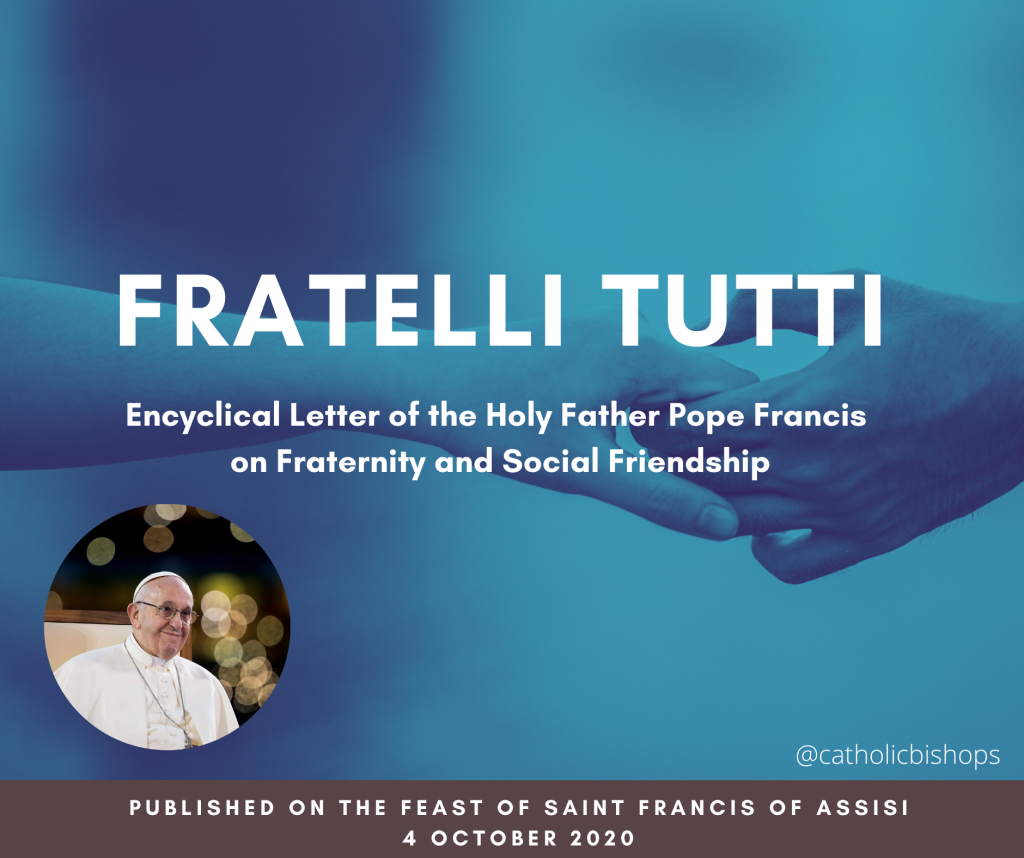
I prepared this homily against the background of the release of Pope Francis’ third encyclical at Assisi on Oct 3, 2020, the eve of the Feast St. Francis of Assisi. The encyclical is titled Fratelli Tutti or “All Brothers” in Italian, and the focus is on “fraternity” and “social friendship.” Since much of the content of the encyclical was yet to be available during the writing of this homily, I have chosen to reflect on a related theme – the prevalence of violence. This theme is inspired by the three parables of the vineyard that we have heard over that last three Sundays. Whereas the previous two parables focused on vineyard owner’s just and compassionate dealing with laborers in the vineyard, today’s third parable reflects on some people’s dealings against the vineyard owner. A landowner leased his vineyard to tenants, who, when the time of reckoning came, beat, stoned, and killed the landowner’s servants and even his son. There is a surprising new element in this parable which is absent in the other two – violence. In reality, this parable summarizes the entire salvation history. More importantly, it is a clear reference to Jesus’ life and ministry as it got played out in human history. Jesus became the victim of the most brutal violence.
Twenty-sixth Sunday in Ordinary Time
These are days of living on edge. The smallest thing can set people off! It is not merely about our inability to have civilized conversations about politics and religion. There are deep and conflicting differences running right through our nation and Church. We are one nation and one church with two irreconcilably differing ideologies and visions. The Church particularly, has never been closer to a schism in recent times.
Twenty-fifth Sunday in Ordinary Time
How often have you cried out, “Its not fair!” I probably say this at least once day. Sometimes I am right on and sometimes I am not. When we experience an injustice in society, we seek justice from the justice system. It is the right thing to do. As Christians too, we believe that justice is a divine quality and that God is a just God. However, in the religious realm, when we have done something wrong and come before God, we don’t seek God’s justice, but rather, God’s mercy. Here, then, is the dichotomy - we know God to be just, but we expect to be treated with mercy. As the Psalmist says, “If you O Lord, should mark our guilt, who would survive? (Ps 103:3). If God treated us sinners in the same way that the justice system treats offenders, what would the confessional look like? In the Judeo-Christian tradition, God is known to be both just and merciful. Where do justice and mercy meet? The parable of the generous vineyard owner in today’s gospel reading is an answer to this question. Just to recall, in the parable, a vineyard owner invites laborers to work in his vineyard at various time during the day but pays them all the same wage. This causes the ones who came first to grumble. This also causes Jesus to say, “Are you envious because I am generous?” (Mt 20:15).
In my three points, I would like to address the issue of God’s justice, God’s mercy, and God’s generosity.
Twenty-fourth Sunday in Ordinary Time
This past Friday, I began an eight-week series on John of the Cross, and I want to begin my homily with a story from his life. In mid 16th Century, John, along with Teresa of Avila had undertaken a reform of monastic life. This led to no little discontent among the calced Carmelites. John became a victim of the malice of some of his brothers. One cold December night in 1577, a group of armed calced Carmelites came to his monastery, kidnapped him and put him in their monastery prison. He was accused of rebellion. As if that was not enough, after two months of imprisonment, afraid that he would escape, was moved to a mere 6x10 prison cell with no ventilation, and only a little crack near the ceiling to let in minimal light. He suffered intensely with lack of food, bathing, and fresh clothes. Lice, near starvation, near fatigue, and physical and mental abuse almost killed him. After nine months of abject misery, he managed to get out of imprisonment in a daredevil and almost miraculous escape. It took months for him to recuperate. After he recovered from his effects of his dreadful imprisonment, one barely hears John of the Cross talk about this event. Instead, as he would put it, he saw the hand of God in the experience and urged others not to speak uncharitably about his persecutors. Once when one of his companions reminded him of his suffering, John said, “Padre, this is not the time to be thinking of that; it is by the merits of the blood of our Lord Jesus Christ that I hope to be saved.” As the book of Sirach says in today’s first reading, “Anger and wrath are hateful things!” (Sir 27:30).
Twenty-third Sunday in Ordinary Time
Life is a web of relationships. Relationships are life-giving, but they can also suck the life out of us. Relationships can make life easy, but we can also find ourselves entangled in this complex web. Think, for example, about how marriage creates a whole new network of relationships. On the reverse think about how a divorce throws but an entire network of relationships into chaos. Or think about the pandemic, and the way in which it has reprogramed us to manage our relationships. Some families have found the pandemic to be a time for great bonding. However, the steep increase in domestic violence and unintended pregnancies tell us that there is another side to the story. Or, think about our present political and social climate. If you have not found your relationship with a family member or long-time friend under tremendous stress, then thank God, because you are an exception.
Twenty-first Sunday in Ordinary Time
Scripture Readings
Not because Jesus was conducting a straw poll did Jesus asked the disciples who the people thought he was. Neither was he having an identity crisis to ask them who they thought he was. There are two parts in today’s gospel reading. In theological terms, there is a Christology and an ecclesiology. The first part consists of Jesus’ two questions to his disciples. It concludes with Peter’s confession, “You are the Christ, the Son of the Living God” (Mt 16:16). It gives us an insight into Jesus’ identity. This is the Christology. The second part is Jesus’ declaration of Peter as the “rock on which I will build my church” (Mt 16:18). This Church, even “the gates of the netherworld shall not prevail against it.” (Mt 16:18). As Jesus says, it “my church.” This gives us an understanding into the church. This is the ecclesiology.
Twentieth Sunday in Ordinary Time
It is very tempting for me to delve right into the gospel reading and the curious yet amazing story of a despised mother, who within a matter of seconds, turns into a model of faith. But I shall resist that temptation. Because, even though there is a despised mother who shows exemplary faith and her daughter is miraculously healed, the story that is being narrated is a different story. “My house shall be a house of prayer for all peoples” (Is 56:7). This is the main plot of today’s story. The story of the woman who gains Jesus’ praise is a sub-plot that supports the main plot.
I have three points for you today. I am going to build this homily towards Isaiah very first statement in today's first reading, "Observe what is right, do what is just" (Is 56:1).
Nineteenth Sunday in Ordinary Time
Do you think that Jesus ever felt frightened? Were there moments in his life where he was overcome with fear? The gospels have no recorded instance of Jesus being afraid. The only instance that we can assume that he was afraid was at the garden of Gethsemane, where Luke tells us that, “He was filled with such agony and prayed so fervently that his sweat became like drops of blood” (Lk 22:44). On the other hand, the gospels narrate numerous instances of Jesus urging his disciples not be afraid. Last Thursday, on the feast of the Transfiguration, we heard Jesus come to his frightened disciples and say, “Rise and do not be afraid!” (Mt 17:7). Today, yet again in the gospel reading Jesus came to the rescue of his terrified apostles and said, “Take courage, it is I; do not be afraid!” (Mt 14:27).
Eighteenth Sunday In Ordinary Time
The multiplication of loaves and fish is the only miracle found in all the four gospels, and surprisingly, twice in the gospels of Matthew and Mark. On the peripheral level, it can be read as yet another miracle in Matthew’s string of miracles that reveal Jesus’s Messianic identity. Indeed, it is! On another level, the passage is so full of symbolism and deeper meaning that a peripheral reading does not do justice to this miraculous event. There is a miracle within the miracle. I would like to explore the deeper meaning of Matthew’s multiplication narrative in a way that could transform hearts!
Seventeenth Sunday in Ordinary Time
One of the dialogue lessons in my Spanish learning app is about a girl, who while looking around in the attic, accidentally discovers a lamp. As she cleaned it, suddenly, a genie appeared. The genie asked the girl to make three wishes. The girl’s first wish was that all the stray animals may find shelter. The genie was surprised that she did not ask for things that girls her age would wish. The genie obliged. “Do you not want to be famous?” the genie said to her. She replied, “No, but can you make sure that the river in the city is clean again?” He granted her second wish too and asked if she would like some brand-new outfits. Again, she refused to ask anything for herself, but rather wished that her uncle who is ill might be healed! Impressed at how selfless the girl was, the genie decided to give her a fourth bonus wish. She was thrilled, but to the great dismay of the genie, she asked that her fourth wish be that the genie grant her a thousand wishes. Her first wish of the thousand wishes was that he addresses her as “Your Highness!” Her second and third wishes were for a new car and that she might indeed be famous!”
It sounds like an improbable story. However, the story of God and Solomon in today’s first reading is very similar. God said to Solomon, “Ask something of me and I will give it to you.” The rest is history. We must recall, though, that Solomon’s story also has an ironic end.
Sixteenth Sunday in Ordinary Time
I have received more DMs (direct messages) across my social media platforms about faith and spirituality these days than I have ever done before. I have had messages from people seeking spiritual directors, people wanting to come to the Sacrament of reconciliation after many years, people seeking to reconnect with the church, people wanting to rediscover their faith - people who are simply longing for a more tangible presence of God. I think there is a reason. The pandemic has severely restricted our family, social, community, and religious life. Not only are people feeling isolated from their loved ones, but they are also feeling alienated from themselves. As for faith, I think that people are missing the tangible things that nurture faith – holy water, a personal sign of peace, a hug, volunteering at the food pantry, liturgical ministries, and most of all, Holy Communion. Especially if faith and spirituality have been on the back burner, some people are even feeling distant from God. Now, more than ever, people are looking for meaning. If you are one of those people, today’s scripture reading come to our aid.
Fifteenth Sunday in Ordinary Time
If Jesus walked among us today, I wonder what parable he would preach? Amidst the pandemic, the social unrest, the racial inequalities, the dehumanization of the human person, the degradation of the environment, what parable would Jesus use? The use of parables to teach faith lessons was one of the most brilliant strategies that Jesus employed. He used imageries and analogies from daily life in these parables. Parables by nature are open ended. By this I mean that a hearer can draw multiple meanings from a single parable. For that matter, a parable never runs out of meanings. That is why, the two-thousand-year-old parable of the Sower and the Seed continues to be highly relevant even today.
Fourteenth Sunday in Ordinary Time
“All life comes from tenderness.” These are the words of the famous French poet, Charles Péguy. Tenderness - the word evokes strong emotions in me. In 2017, Pope Francis was invited to deliver a TED talk at the annual TED conference. The title of the conference was “The Future You.” TED is known for coaching its speakers to deliver the most effective and optimal performance. Pope Francis decided to prepare his message all by himself. I hope you are not surprised, but Pope Francis made three points in his talk. In his third point, Pope Francis called for a "revolution of tenderness." In today’s gospel reading, Jesus says to his hearers, “Come to me, all you who labor and are burdened, and I will give you rest” (Mt 11:28). Jesus was calling for a revolution of tenderness.
Thirteenth Sunday in Ordinary Time
Today’s scripture readings begin with a delightful and heart-warming story. An influential Shunammite woman provides extraordinary welcome and hospitality to the prophet Elisha. At first, she invited him home for dinner. But as time goes by, she offers him a small room and furnishes it with a bed, a table, a chair and a lamp. No reward was expected. She only did this because Elisha was a man of God. However, she is not left without a reward. She and her husband had been childless, and Elisha promises them a child. The promise was fulfilled. In many ways, this story foreshadows Jesus’ words in today’s gospel, “Whoever receives a prophet because he is a prophet will receive a prophet’s reward” (Mt 10:41). Jesus goes further. Even a cup of cold water does not go unrewarded! (Mt 10:42).