Wednesday of the First Week of Lent
After returning home from a mission trip (where I volunteered to work with children who had been removed from their homes as a result of the situations there), I was seriously angry at God. Realizing the anger was something that I needed to deal with I sought the Sacrament of Reconciliation.
“Jonah, isn’t he the whale guy?” This was the question that I asked the priest who had just assigned me reading Jonah as part of a penance. As a teenager who was unfamiliar with the story beyond the children’s illustrated version of the Bible,I failed to see any connection whatsoever between my confession and this penance.
Tuesday of the First Week of Lent
The word "Lent" comes from the Old English word læncte, which means "lengthening" or "springtime". Spring (in our eco-region) is a time of rains, longer days, change and growth expressed in today’s first reading. I grew up in Winnipeg, Canada, where foot-high snow often covered the ground throughout Lenten March. The snowmelt took weeks through April/May and as children we longed for the snow piles to melt so we could shift from hockey on ice rinks to street ball hockey and the snow-clear baseball season. We jumped on the ice-covered puddles to break them up and help the process along. Streets became mini-streams as the waters drained from roadways into our rivers and lakes. We couldn’t shift from snow boots to shoes until the ground was drier and the streets cleaned of the winter gravel and salting. The process took time. Melting snows are an important source of water for the deep soils of the North American prairies, which produce wheat and other grains as a ‘breadbasket’ for the world.
Monday of the First Week of Lent

Leviticus. Whenever I taught the Hebrew scriptures over the years my commentary on Leviticus: a sure cure for insomnia.
But that is hardly fair, in retrospect. Today’s 1st reading comes from the section of the book called the “Holiness Code.” Here, through his prophet Moses, YHWH is prepping the Chosen People for entrance into Canaan from where they were to become a blessing to the nations. And it is rooted in the call to be holy as YHWH is holy. Here the Priestly writers/editors of the Pentateuch (the first five books) repeat most of the Ten Commandments, defining what it means to be holy under the Holy One of Israel.
Saturday After Ash Wednesday
We are at the beginning of Lent. Today’s readings give insight into how we are to be throughout this season.
Friday After Ash Wednesday
I’ll be honest. I don’t really like fasting. I can easily be tempted to avoid it or find excuses for not fasting, but I do like what comes from it, the fruit of the discipline of it. And, of course, without the discipline we miss out on its fruit. I know I’m not alone in not particularly liking fasting. Afterall, it wouldn’t require discipline if it was easy or enjoyable. Yet, in some ways fasting is easier than what the Prophet Isaiah calls us to in today’s First Reading (58:1-9a).
Thursday After Ash Wednesday
As disciples of Jesus we are called to imitate Him in our daily lives. Today, Jesus tells us that we must deny ourselves and “take up our daily crosses.” What might that mean for us as Catholic Christians?
In today’s Gospel reading, Jesus tells His disciples about His passion, death and resurrection. He further explains that His disciples must also “take up the cross daily” to follow Him. It is when we “lose our life” for Jesus, that we are saved. As I reflect on this reading, I wonder what the disciples were thinking about these challenging commands.
Ash Wednesday
“Even now, says the LORD, return to me with your whole heart, with fasting, and weeping, and mourning; Rend your hearts, not your garments, and return to the LORD, your God. For gracious and merciful is he. . .” Thus begins our first reading from the prophet Joel. In our Gospel, Jesus calls us to pray, fast, and give alms as oblations of charity, as sacrifices of praise. The Church offers us this graced season of Lent as an opportunity to repent, to return to the Lord, to experience conversion. Let us consider today how we will enter into God’s invitation to become more like Christ.
Tuesday of the Eighth Week in Ordinary Time
My father died on Mardi Gras. Actually 25 years ago this year. But one of the most vivid memories I have of that time is the advice given to me the day before by an elder Marianist Brother that I was close to. We had been in communication about my worry about my Dad’s health and he said to me: “Wrap him in the Lenten Mystery.” My father went to heaven the next day, and I had no doubt about what I was “doing for Lent” that year.
Monday of the Eighth Week in Ordinary Time
At sundown tomorrow the great Paschal season of Lent-Easter begins. Some of us who knew the pre-Vatican II Church experienced Lent very differently than today. We grew up in a church caught between the eras of the Council of Trent and the Second Vatican Council. What follows are some recollections on my part just prior to my twelfth birthday when everything seemingly changed (although the essentials remained the same).
Saturday of the Seventh Week in Ordinary Time
In today’s Gospel, Jesus’ disciples rebuked the children for coming to Jesus. Consequently, Jesus gets angry at his disciples and tells them that they must be like children in order to enter the Kingdom of God. To our modern understanding, this might not make much sense. What message does this Gospel have for us today?
Friday of the Seventh Week in Ordinary Time
There is a well-known quote that states, “We are the average of the five people we spend the most time with.” I usually laugh when I read it because I wonder what that says about me considering that at least 4 of those people in my life are under the age of 10, so if I take the average ages of my children and my wife (even though that’s technically six people), I’m about the equivalent of an 11-year-old. I’m sure there is plenty of debate and disagreement about the accuracy of the above statement, but I do believe there is some truth to the idea that we are shaped by the people we surround ourselves with. Our first reading today from Sirach offers a compelling framework for the value of good friendship.
Thursday of the Seventh Week in Ordinary Time

“Salt is good, but if salt becomes insipid, what will restore its flavor? Keep salt with you and you will have peace with one another.” - Mark 9:50
Wednesday of the Seventh Week in Ordinary Time
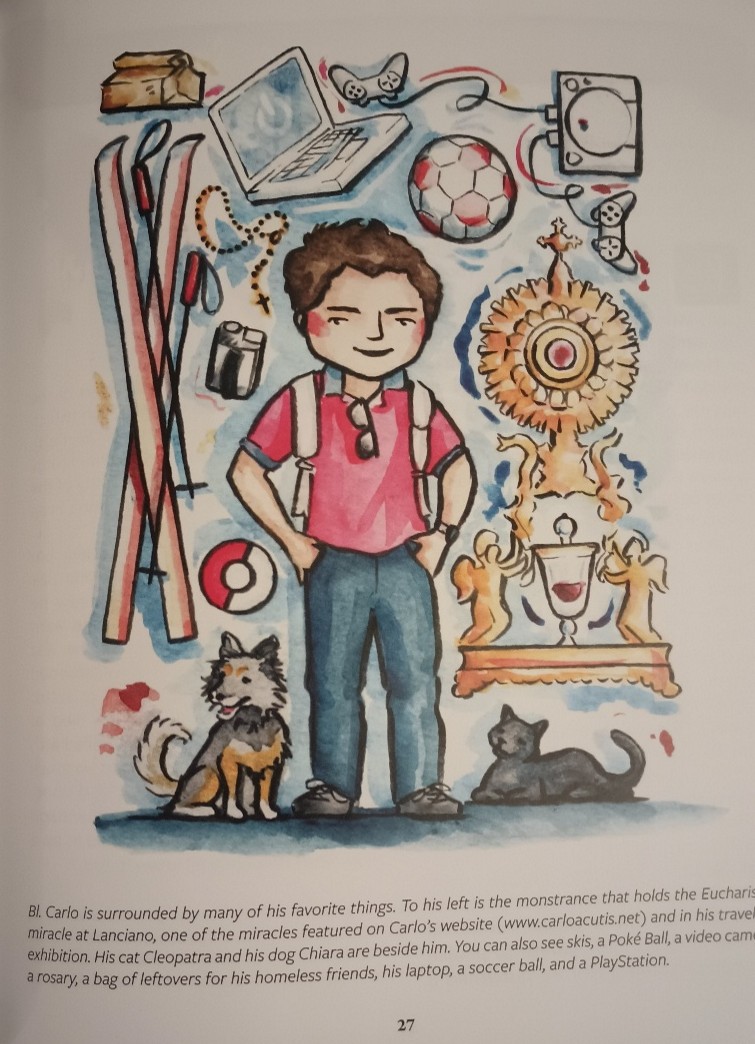
Just yesterday, my 6-year-old son, Ben, was looking through our copy of Saints Around the World (a beautifully written and illustrated collection of holy men and women of our church), when he opened up to this picture of Blessed Carlo Acutis. He was pointing to all the things he recognized in the picture – the dog, the cat, the soccer ball and the video games. He looked up and said, “Why is there a poke-ball on here? He’s a saint, why would he have Pokémon on his page?” I couldn’t help but smile at the innocence of this question. I could hear the deeper meaning in his question. It felt to me like he was asking - did this person, who you tell me is a SAINT, actually play Pokémon? I think it surprised Ben so much because he loves Pokémon, but I don’t think he sees himself as much of a saint. Suddenly this person who has lived a holy, saintly life seems very relatable and real.
Tuesday of the Seventh Week in Ordinary Time
“Life is difficult” is the opening line of one of my favorite books, The Road Less Traveled by Scott Peck. Today’s readings similarly remind us to prepare ourselves for trials in our Christian service and stance for justice. Though I would like all moments to be happy and easy-going, I recognize that It takes diligent work and virtuous discipline to be a faithful worker, friend, partner, or family/community member. It takes courage to act justly and speak for the disadvantaged.
Monday of the Seventh Week in Ordinary Time
“I do believe. Help my unbelief.” These oft quoted words from Mark resonate and are among the most popular verses in the New Testament. We desire faith, and yet it eludes us. We may wonder why we doubt when faith is so desperately needed. Is God disappointed that we fail to embrace faith totally and without question?
Feast of the Chair of St. Peter, Apostle
Today is the Feast of the Chair of St Peter. I know, we Catholics are not only crazy enough to bless our cars, houses, and pets, but we also have a feast day for a chair! We are an interesting breed aren't we?
Obviously, this is not the feast day of a wooden object with four legs and cushion, or even a rocking chair for that matter. We know this because in the Biblical sense, the chair or seat of someone is their position of authority, governance, or power. Hence Christ tells the people “The scribes and the Pharisees sit on Moses' seat; so practice and observe whatever they tell you, but not what they do; for they preach but they do not practice” (Mt 23:2-3 RSV). Thus, today is the feast day of Peter's position, his seat of authority, which really means that this is a feast day that celebrates the promises of God as well as, the call for power and authority to be transformed by Christ. That transformation is what I want to focus on today, (despite my temptations to write exclusively about the significance of the giving of the keys).
Optional Memorial of St. Peter Damian, Bishop and Doctor of the Church
“For the time will come when people will not tolerate sound doctrine
but, following their own desires and insatiable curiosity,
will accumulate teachers and will stop listening to the truth….”
(2 Timothy 4:3,4)
Drawing on the readings for today’s optional memorial of St. Peter Damian, Bishop and Doctor of the Church, the above verse from the first reading stood out to me. At this time when there seems to be much disregard for the truth, this letter to Timothy might well speak to us today: “proclaim the word; be persistent whether it is convenient or inconvenient; convince, reprimand, encourage through all patience and teaching.” (vs 2)
Thursday of the Sixth Week in Ordinary Time
Do you ever wonder why certain things happen? I believe completely in a God who is all love, so when I hear and see something that seems horrific- a tsunami that kills thousands of people, a bomb that explodes in a crowded marketplace, an accident where an innocent bystander is killed- whether one or many people are involved- I wonder why would God allow this to happen. Both readings today made me stop and think about God and His role in our world. After some reflection, I realize that my tiny mind can never fully understand or appreciate God’s love and how that is expressed even in the messiness of this world.
Wednesday of the Sixth Week in Ordinary Time
Our Gospel today presents one of Jesus’ healing miracles (a blind man). Taken at face value, we are inspired by our Lord’s compassion and power to heal. We can also read this account as a real-life parable. In it we are meant to recognize the disciples’ gradual coming to faith and understanding of Christ and his mission; in it we are invited to contemplate our own spiritual journey and recovery of sight. Today, let us ask the Lord to heal us of our spiritual blindness so that we might see more clearly the plans and purposes of God and follow him more closely.
Monday of the Sixth Week in Ordinary Time
“Offer to God a sacrifice of praise” is our psalm response today (Psalm 50). This got me thinking back to how I have and have not experienced mass as “a sacrifice of praise.”
I was twelve years old when Vatican Council II concluded in 1965. So technically I grew up in the Church of the Council of Trent, the last ecumenical council. 1962-1965 and years immediately following were exciting as well as unsettling. The church, which “changes” at a snail's pace, was changing in leaps and bounds, week to week.