Feast of the Dedication of the Lateran Basilica in Rome
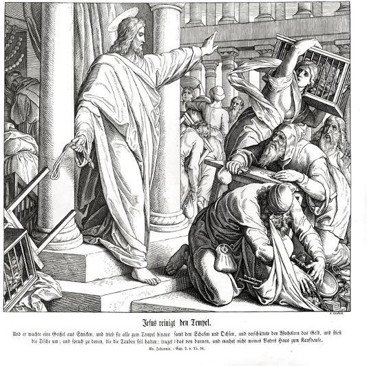
Mark was the first to write a narrative of “the cleansing of the Temple.” He places the incident after the “triumphal entry” of Jesus into Jerusalem. Matthew & Luke follow suit.
Scholars contend that these events put a target on Jesus’ back. Jerusalem is a tinderbox on important Jewish feasts like Passover and Jesus had just struck a match. The Roman governor would enter the Holy City, coming from his Roman Villa at Caesarea-on-the-sea, on the feast to quell (violently if necessary) this very thing.
It was the responsibility of the Jewish high priest, in this case Caiaphas, to alert the Roman authorities if there were troublemakers. Sadducees like Caiaphas walked on eggshells, knowing what Rome was capable of if there was a riot. And procurator/governor Pontius Pilate, with a reputation of absolute ruthlessness, would “take no prisoners.” Pilate disdained the Jews on a level far beyond hate. Tiberius would eventually remove him as procurator of Judea in 36 CE because of his many atrocities, including crucifixions without trials.
We have come to call the incident in the temple its “cleansing.” It is as historical an event as anything in the Gospels. But is “cleansing” really what Jesus wanted to do? Some suggest that he was symbolically eliminating the Temple and replacing it with the Kingdom of God. The Jesus movement/ Followers of the Way was all about God’s reign. “The Kingdom of God is within you.” “The Kingdom of God is in your midst.” Why need a Temple then?
Today we hear John’s version of the Temple incident and he places it not in Holy Week but rather at the very start of the Lord’s ministry. John’s reasons weren’t historical (Jesus didn’t “eliminate” the Temple twice) but serve the Fourth Gospel’s theological purpose.
A generation prior to John’s Gospel, Paul wrote to the People of God at Corinth: “You are God’s building.” And our foundation is Jesus Christ. Apt words for Catholics these days of closings and mergers of parishes, churches, and schools. And even Dioceses.