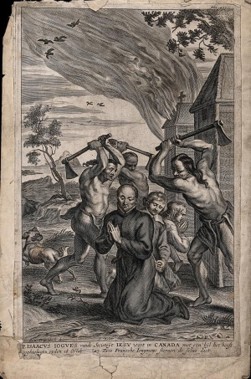
Memorial of Saints John de Brébeuf and Isaac Jogues, Priests, and Companions, Martyrs
Attitudes towards accumulating “stuff” is a theme in Luke/Acts and front and center in today’s parable. A prosperous man accumulates more and more. He calculates how his plush life will be even more secure. But death befalls this “fool” with appalling swiftness.
This is the only parable in which God directly addresses a character in the drama. “You fool! Tonight your life is being demanded of you! And the things you have, whose will they be?” (Luke 12:20) Jesus warns, “Woe to you who are rich now, for you have received your consolation” (Luke 6:24).
Wisdom literature warns against wealth as the goal of life. “Do not wear yourself out to be rich; be wise enough to desist. When your eyes gaze upon it wealth is gone; for suddenly it takes wings, flying like an eagle toward heaven” (Proverbs 23:4-5).
The search for wisdom, living in tune with God, ought to be life’s ambition. The Lord “stores up sound wisdom for the upright” (Proverbs 2:7). This is a far better storehouse than silos of grain. Wisdom is equated not with longevity and prosperity, but rather with a relationship with God that death itself can’t take away.
Today we recall Jesuits Sts. Isaac Jogues, Jean de Brebeuf and companions. In the US and Canada it is an obligatory feast and not a memorial. These Jesuit saints offered their lives and met horrific fates in the harshest conditions. The world may look at these men as “fools.” Feast days like today beg the question: will we persevere as did the holy martyrs, or will our attachments to wealth and comfort weaken us?
Unlike other parables, in today’s God speaks to the fool directly, divulging the futility of his priorities and revealing the timing of his demise. While none of us gets the timing memo, we have all been given the futility memo. In a matter of hours the fool is the richest man in the cemetery.
Rabbi Jesus, itinerant preacher and master storyteller, would have ended his parables with one question: “How is the Kingdom of God like that?” How do we respond to that question with regard to the parable we hear today and the model that the North American martyrs give?
Our choice is clear.
-Timothy J. Cronin