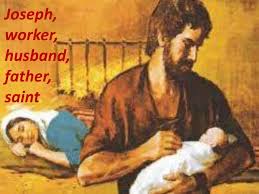
Saint Joseph has many titles: Patriarch, Son of David, the Just Man, Savior of the Savior, Patron of Refugees, Terror of Demons, Head of the Holy Family, Patron of the Dying, Model of Artisans, Patron of the Universal Church. I have always liked the title, “Saint Joseph the Provider.” A school in Youngstown is named this in Joseph's honor.
Work is a holy thing, a divine thing. The first chapter of the Bible shows the dignity of work, featuring God’s labor. For six days the Eternal One creates all that is.
The Priestly writers and editors of Genesis beautifully render this in Genesis 1:1-31 as a great litany, in liturgical and lyrical form.
Thus, labor itself is made holy. On this Feast of Joseph the Worker we are reminded of this truth.
Father Roger Landry offers the following:
One’s desk, or sewing machine, or kitchen, or chalkboard, or operating room, or workbench, or boat, is meant to become an altar which sanctifies not only what is given to God in work, but the giver as well. It is there that we are sanctified and sanctify others through showing the dignity of human work.
Work, this feast day teaches, is not principally about earning a paycheck, but about serving and loving others. When work takes on this meaning, the work-place is evangelized, and God’s work is advanced. In every age, a diligent construction worker from Nazareth, together with Saint Joseph, waves to each of us with calloused hands and says, “Come, follow me!”
The very word “liturgy” (leitourgos in Greek) means “public work” of the Church. We learn by the way we pray the Mass how to pray our work. Thus the entire world becomes God’s workshop, God’s leitourgos.
Let us ask St. Joseph the Provider, savior of the Savior, to intercede for us to the Savior that he saved. Then we can do our work well, grow in holiness, and “provide” service to others along the way.
-Timothy J. Cronin